mardi 4 mars 2014

French Metis in the Willamette Valley

I wrote for our local newspaper, the Register Guard, a piece about the Quebecois in early Oregon, particularly on the French Prairie. Here's the link to Oregon's early pioneer history has a French accent. A relevant photo from the trip Josh and I took to St. Paul back in mid February:


This is the first of twelve panels listing the people buried in the cemetery (according to parish records, the gravestones are all gone.

dimanche 23 juin 2013

John Day

John Day and the Astoria expedition:

Last week Josh and I floated down the John Day river in eastern Oregon. I was the third trip I've made on the river, but the first time I really wondered who John Day was and why this river was named for him. The river is notable in Oregon history mainly for the brief gold rush to Canyon City in 1862. Canyon City is near the town of John Day on the south fork of the river, well upstream of the part we floated. Prospectors traveled there on a route from the Dalles which crossed the John Day River downstream of Clarno (below the section we floated). Interpretive signage, such as in Antelope, recalls this period, and the stagecoach that ran along this route.

I took along on our trip the book Astoria, by Washington Irving, because I believed that the overland Astoria expedition may have traveled down the river in 1811 or 1812. It turns out they did not. They attempted to canoe down the Snake River, until they encountered rapids which destroyed their boats and supplies, and took the lives of a couple members of the expedition. Without going into the gory details, suffice it to say that the survivors split into several small groups and proceeded on foot from the Snake overland across Northeast Oregon to rejoin the Columbia somewhere between the Dalles and the tri-cities area. So they presumably cross the Blue Mountains or the Wallowas. In Astoria the geography is extremely vague, since when Irving wrote the Oregon Trail had still not been plotted and rutted, and the region was little-known except to Native people.

John Day joined the expedition during its voyage up the Missouri River in the autumn of 1810. He is introduced as:

a hunter from the backwoods of Virginia, who had been several years on the Missouri in the service of Mr. Crooks, and of other traders. He was about forty years of age, six feet two inches high, straight as an Indian; with an elastic step as if he trod on springs, and a handsome, open, manly countenance. It was his boast that, in his younger days, nothing could hurt or daunt him; but he had "lived too fast," and injured his constitution by his excesses. Still he was strong of hand, bold of heart, a prime woodman, and an almost unerring shot. He had the frank spirit of a Virginian, and the rough heroism of a pioneer of the west.

You see here the kind of heroic physiognomy that Irving bestows on his favorite men. The status of a "Virginian" is elite, as with Daniel Boone, even decades after the man departs Virginia. He has the virtues of the Indian without, of course, the weaknesses. But he does have a weakness, or at least Irving plants the doubt that foreshadows what will happen later.

In reading Astoria I was paying attention to how Irving describes the Canadien voyageurs (who made up the majority of the men on both the overland and the maritime expedition to Oregon), and the contrasts between how Irving treats the voyageurs and how he describes the anglos, such as in his portrait of John Day. The maritime travelers, including Gabriel Franchère, whom I blogged about last spring when I was reading his narrative in French, were hired at Montreal, and the overland voyageurs signed contracts at Montreal, at Mackinac, and at St. Louis. They were hired to perform the grunt labor of the expedition, the paddle the canoes or pirogues and to carry the pelts and supplies across portages or overland. Most of these Canadiens (unlike Franchère) were illiterate, and so left no record of their own thoughts and experiences on the expedition. Irving rarely mentions their names; they are a mass of labor, not worth distinguishing as individuals. Here's a typical passage from chapter 17, when the anglo leaders Ramsay Crooks and McLellan are worrying about threats from the Teton Sioux whom they will have to pass as they continue up the Missouri:

All these causes of uneasiness were concealed as much as possible from the Canadian voyageurs, lest they should become intimidated; it was impossible, however, to prevent the rumors brought by the Indians from leaking out, and they became subjects of gossiping and exaggeration. The chief of the Omahas, too, on returning from a hunting excursion, reported that two men had been killed some distance above, by a band of Sioux. This added to the fears that already began to be excited. The voyageurs pictured to themselves bands of fierce warriors stationed along each bank of the river, by whom they would be exposed to be shot down in their boats: or lurking hordes, who would set on them at night, and massacre them in their encampments. Some lost heart, and proposed to return, rather than fight their way, and, in a manner, run the gauntlet through the country of these piratical marauders. In fact, three men deserted while at this village. Luckily, their place was supplied by three others who happened to be there, and who were prevailed on to join the expedition by promises of liberal pay, and by being fitted out and equipped in complete style.

The voyageurs are said to be strong, tireless, jolly, and forebearing, but fearful and vain. They are expendable and replaceable.  The "style" they enjoy is not elaborate, it can be satisfied with feathers in their caps. Nicole St-Onge has studied the account books of the overland expedition, kept by the Irish clerk John Reed, which reveal the voyageurs unwritten predilections better than any other surviving sources. They held out for higher pay than was typical for voyageurs who worked along well-established routes, but many of them also spent their wages quickly on liquor, clothing, and rare feathers.

To get back to John Day, his most significant role in the Astoria is when he and Ramsay Crooks succeed, just barely, in reaching the Columbia near Walla Walla. "Mr. Crooks remained here twenty days, detained by the extremely reduced state of John Day, who was utterly unable to travel, and whom he would not abandon, as Day had been in his employ on the Missouri, and had always proved himself most faithful." The Walla Wallas help them, but when they proceed down the Columbia, they are robbed by locals near Celilo Falls, and "stripped naked" with neither rifles nor flint and steel. They return to Walla Walla for charity. They finally succeed in reaching Astoria on the 11th of May, 1812.

But on the return voyage the party again encounters starvation and cold weather along the Snake River, and it proves too much for John Day:

the poor fellow's wits had been partially unsettled by the sufferings and horrors through which they had passed, and he doubted whether they had ever been restored to perfect sanity....The sight of any of the natives put him in an absolute fury, and he would heap on them the most opprobrious epithets; recollecting, no doubt, what he had suffered from Indian robbers.
On the evening of the 2d of July he became absolutely frantic, and attempted to destroy himself. Being disarmed, he sank into quietude, and professed the greatest remorse for the crime he had meditated. He then pretended to sleep, and having thus lulled suspicion, suddenly sprang up, just before daylight, seized a pair of loaded pistols, and endeavored to blow out his brains. In his hurry he fired too high, and the balls passed over his head. He was instantly secured and placed under a guard in one of the boats. How to dispose of him was now the question, as it was impossible to keep him with the expedition. Fortunately Mr. Stuart met with some Indians....the Indians executed their task faithfully, and landed John Day among his friends at Astoria; but his constitution was completely broken by the hardships he had undergone, and he died within a year.

John Day apparently suffered from a form of PTSD, a rare flaw in character for an heroic Virginian. Oddly enough, other sources claim that he lived until 1819 or 1820.

lundi 16 juillet 2012

Monuments, Memorials and Site Inscriptions

In what I've read of academics writing about monuments and memorials, I find little agreement about the definitions of those two terms. A memorial invokes memory, obviously, but it need not necessarily be dedicated to the memory of a deceased individual. A monument is, well, big, it is built to be noticed. Art historian Michael J. Lewis proposes that, “a monument is the expression of a single powerful idea in a single emphatic form, in colossal scale and permanent materials, made to serve civic life. (Materials and size distinguish monuments from memorials, of which monuments are a subset).” (2). Lewis was writing in Imprimis, a free pamphlet distributed by the right-wing ideologists at Hillsdale College in Michigan. The title of his piece “The Decline of American Monuments and Memorials” critiques the new Martin Luther King memorial and the plans for a Dwight D. Eisenhower memorial.

In studying Quebec City I have come to focus on the connection between monuments, memorials, and place. This relationship is not obvious, for whereas a gravestone is meant to mark the site where that person is buried, a memorial need not mark any particular site. Kirk Savage, the author of two fine books about the monuments and memorials of Washington, D.C., in writing of the Lincoln Memorial, says “the monument is not, properly speaking, a sacred site. Typically it holds no relic or spiritual trace of a past presence. The site of the Lincoln Memorial, for instance, did not even exist in Lincoln’s lifetime; it sits quite literally on mud dredged from the Potomac River bottom” (6). Savage goes on to explain how in the 19th century the National Mall was a park with many trees and winding paths, but few museums or monuments. The city had plenty of statues of great men, but they were dispersed around the city such as in the circles where radiant streets meet. In the late 1800s and early 1900s a modernist plan cut down all the trees and added the reflecting pool, a series of new museums that continues today, and streets and parking for cars, changing “public grounds” into “public space.” Public space is abstract, relational, and visual. For instance the new plan emphasized the axis running through the Capitol and the Lincoln Memorial and RFK stadium at the eastern end. This made possible the huge marches and celebrations for which the Mall is famous. With all those trees still in place few people could have watched MLK give his “I have a dream” speech or Barack Obama take oath of office at his inauguration.

So the many memorials in DC create a network or hierarchy of place and power, in that the relative significance of the person can be discerned from the size and location of the monument, but few of them actually commemorate events that occurred at that location. Washington DC was built from scratch to be the capital city, it did not arise from an important pre-national event, as Quebec City did.

I want to analyze instead the ways in which much smaller monuments or memorials commemorate events and persons connected with the spot which they mark. I will call it a site commemoration or site inscription. Among the most common is the now-cliché "George Washington slept here" or more general "so-and-so lived here." However, these are often intended less to honor the historical individual than to enhance the value of the building on which the plaque is mounted. I am specifically interested in site inscription as a simple marker on the (presumptive) site of an event, a non-monument that has no statue, no representational or artistic content, only a sign or plaque, often mounted on a rough stone, with simple text such as the “Here Wolfe fell” and the "Montcalm, Vaincu, Blessé a mort ici" that I discussed in an earlier post. The site inscription doesn’t really qualify as a monument (because it is too small) nor as a memorial (since it doesn’t necessary involve death nor a single person).  

At a site inscription there’s nothing to touch, nor to look at, no palpable connection to a person or event. There's no mortal remains and no relic (although such relics connected with the site may be found elsewhere). The site inscription invokes (or tries to invoke) among viewers an act of commemoration that resembles the reverence and singularity of a gravesite, without the metonymic relic. The marker doesn’t try to manufacture an aura (as at the Lincoln memorial) but only invoke one, as if the aura already inhered in the site or place. I think Native American “sacred sites” and the New Age religiosity about “sacred spaces” may have helped to sustain this effect and make it more influential. This abstraction is akin to the simplicity of radical protestant houses of worship, Quaker meeting house. The power must reside in the minds and memories of the viewers. At many such markers there are no scheduled events to bring together the community of commemorators, and so it must be an an individuated ritual or invoke an imagined community. It is up to the visitor to determine how to feel or whether to care, but the political interpellation (to use Althusser’s term) is usually pretty obvious.

One of the most provocative of these site inscriptions in Quebec is at the base of the Cote Gilmore, next to a stoplight on the busy Boulevard Champlain, the former Anse à Foulon before the anse or cove was filled in to build an industrial port. This granite boulder bears a plaque reading: “The first Reigning Sovereign / who ever set foot upon Canadian soil, / King George VI, / Made his first landing here, at Wolfe’s Cove, / Together with / Queen Elizabeth, / on the 17th of May, 1939.” (with French text below, of course). This is a powerfully imperial Anglo gesture and I can imagine how it might have provoked a francophone response (although I don’t yet know when it was erected). If the King visited of course he had to come ashore, and why does it matter where? Because it was the same spot where Wolfe came ashore the morning of Sept. 13, 1759 for the battle that secured the conquest of New France.


Halfway up the Côte Gilmore, a street so steep it is closed in winter and poses a challenge to avid cyclists in summer, is this monument. I think the two go together, and invite the tourist to climb the hill as a reenactment of Wolfe's conquest, even as it implies King George himself did in 1939. As Serge Tisseron writes in a study of monuments: “entrer dans le monument ou, mieux encore, l’escalader, permet de nous l’approprier et de nous l’assimiler bien mieux que de seulement le regarder.”

He was thinking of massive monuments such as the Eiffel Tower or Statue of Liberty, but I think the same holds true for site inscriptions that trace sequential commemorations. The archetype would be the via dolorosa in Jerusalem, following the fourteen (originally only eight) stations of the cross, each of which is marked with one or more plaques or signs. The tourist or pilgrim cannot see direct evidence of what happened on that site, and in some cases the location or event is disputed, but site inscriptions ask the viewer to commit to an act of memory, and a sequence of inscriptions is more effective at putting the visitor through an initiation ritual, at installing a sense of loyalty or belief.

dimanche 27 mai 2012

Gabriel Franchère

I titled my blog Oregon and Quebec and in one post I acknowledged that many readers (both readers?) likely believe the two places are far apart and have little to do with one another. But one of my goals is to show that in fact many of the earliest Euro-American residents of Oregon came from Quebec. The first Catholic bishops of the Oregon territory were Quebecois. The earliest comprehensive glossary of the Chinook jargon, the trade language used by Indians and trappers in the Oregon territory, was published in Montreal (written by Rev. Modeste Demers, revised by Rev. F. N. Blanchet, in 1870). And among the founders of Astoria, Oregon in 1811, the trading post financed and named for the fur trading magnate John Jacob Astor, was Gabriel Franchère, a Montrealer. He is particularly noteworthy because he wrote a travel narrative that is the best record of the expedition, and was the primary source for Washington Irving's Astoria.

Franchère sailed from New York in September 1810 on the Tonquin, and stopped at the Islas Malvinas or Iles Malouines before rounding Cape Horn, and for a lengthy stopover in Hawaii after the horn. In late March they reached the Columbia, and with great difficulty and the loss of eight men in their launches, crossed the bar. For me, homesick for the Willamette Valley, a great charm of this text is Franchère's reaction to the climate and the vegetation. The enormous trees, the spring flowers, and the success of his garden: “les navets etaient d’un grosseur extraordinaire; nous en mesurames un qui portoit 33 pouces de circonférence et pesoit quinze livres et demie. De douze patates que nous plantames, le produit fut de 90, que nous conservames avec soin pour l’année suivante." But at leaner times Franchère was forced to trade for horses and dogs; the animals that the Indians themselves did not care to eat.

Astor's scheme was inspired by the fact that as the Hudson's Bay company and especially the Montreal based Northwest Company stretched their networks farther and farther into the Rocky Mountains, they pushed against the limits of the yearly routine around which the trade had always been organized. The voyageurs would leave the posts in the spring with furs trapped over the winter, deliver them to Montreal, and return to the posts in the fall with the essential goods Indian trappers needed for the winter. It was not feasible to make this round trip from the upper Saskatchewan River in one season. Moreover, one of the richest markets for beaver, mink, and other furs was now in Canton (China). So a Pacific Coast fur factory could be very lucrative. Trade goods might be supplied in large ocean-going vessels, and furs collected from the western slopes of the Rockies, and shipped directly across the Pacific, along with the seal and otter skins collected along the coast. At last the transcontinental trade that explorers had dreamed of since the sixteenth-century could become a reality!

Astor sent a ship around the Horn, and a separate expedition overland, along the same route used by Lewis and Clark some six years earlier. But at the same time the NW Company traders, including David Thompson, were exploring the Columbia Valley with the same goal as Astor. And on july 23, 1811, Thompson himself showed up in Astoria: “Ce monsieur voyageoit plutot en qualité de géographe qu’en commercant de pelleteries. Durant un séjour de 7 à 8 jours qu’il fit avec nous, il eut occasion de prendre plusieurs observations, étant muni d’un bon quart de nonnante. Et il me parut qu’il tenoit un journal régulier” One thing that amazes me in this book is how the traders and explorers all seem to find each other in this enormous country. When I go hiking I usually have a map and look at it every mile or so. These guys followed directions on a very large scale; something like "ascend the Columbia to its headwaters, turn east, cross over a pass, and..." This was the route Franchère followed home, where he arrived on Sept. 1, 1814.

Franchère was extremely lucky to survive, but not lucky enough to find his fortune. While he stayed at Astoria to build the trading post, the Tonquin set sail to explore the coast, and near Nootka on Vancouver Island was attacked by the Indians and burned. Only one man survived, escaped from captivity and returned to Oregon to tell the tale. The party that crossed overland to Oregon suffered horrible privations. When the War of 1812 broke out and Britain and the United States became enemy powers, the competition for Astoria was no longer merely commercial but political. The Astorians surrendered to the more numerous NW Co. men, and “C’est de cette maniere que je perdis en un instant mes espérances de fortune après avoir franchi les mers et enduré toutes les fatigues et les privations auxquelles je fus exposé en formant l’établissement.”


Franchère kept a diary during his voyage, and wrote a narrative upon his return. In 1820 the editor Michel Bibaud published Relation d'un voyage à la côte du nord-ouest de l'Amérique Septentrionale, dans les années 1810, 11, 12, 13, et 14. This text was used by Irving, along with interviews with Franchère and other members of the expedition. Then an English translation appeared in 1854, and several others after that. But the original manuscript, held now at the Toronto public library, remained unpublished until 1969, when the Champlain Society released it in a bilingual edition. I've purchased a less-expensive French edition from LUX of Montréal.


I look forward to reading Astoria when I get back to Oregon, and perhaps to studying how Irving and others changed Franchère's original narrative. It's final lines are mémorable enough, and Franchère finally reaches his hometown, after paddling all the way from the Rockies. "Enfin après avoir desscendu ce dernier rapide nous mimes pied à terra à Montréal après le coucher du soleil, après quatre ans, un mois, et six jour d’absence. Je m’acheminai immédiatement vers la maison paternelle, ou l’on ne s’attendoit guère à me revois, les nouvelles leur étant parvenues que j’avais été massacré avec M. McKay et l’équipage du Tonquin. Je me retrouvai ainsi au millieu de ma famille et de mes amis, par un effet de la divine providence, qui voulut bien me preserver...”


vendredi 18 mai 2012

Update on Student Strikes

The student strike is at an impasse. On Monday the provincial education minister, Line Beauchamp, resigned. She was deputy prime minister under Jean Charest as well. Charest's defense is that his government promises to add $39 million in bursaries, so low-income students will not be hurt by the $1,778 tuition hike, and says Quebec will still have the lowest tuition in Canada and the best student-aid program. But a hard-core group of protesters turns out nearly every night here and even more in Montreal, and the Montrealais are getting really tired of it, particularly when a smoke bomb in the metro there delayed trips for thousands of commuters last week. I saw reference to another subway disruption yesterday but can't confirm that.
The worst incident in terms of injuries was at the liberal party conference, which had been moved from Montreal to the small town of Victoriaville. The liberal party holds the majority in the "national" assembly, under Premier Jean Charest. So Charest was trying to avoid tying up Montreal, but the student organizations rented a bunch of motorcoaches and turned out in force in Victoriaville. Confrontations with riot police led to one policeman and several students being badly injured. One student lost an eye. 

After that the student associations met with the liberal party leaders and reached a tentative agreement. It proposed small tuition and fee increases for next year, something like $150, and would convene a special committee with members from university administration, faculty unions, and student groups, which would be charged with looking for cost savings in university budgets that could be used to offset the proposed increases, possibly reducing the increase to zero. But as my local host pointed out, administrators have been trained their entire career never to admit that they have been spending too much, and so that committee was never going to succeed. The proposal was sent to student groups for a vote and they all voted it down.

But as I started to write this I had not caught up on the latest news from just last night! The Assembly convened at 8 pm for a special session to debate a bill that would make it illegal for student associations to form picket lines preventing the classmates from attending classes. It would impose steep fines. This news prompted students in Montreal to march around the city until 3 am when they finally got tired and dispersed.

The merit of the student protest I think is that they have turned attention toward the Universities' bloated administrative costs, and claimed that tuition hikes are not necessary even if the province faces a budget crisis. I have no idea how administrative bloat here compares to schools in the US, but at least I get the sense that the students are concerned about educational value for the money, rather than expecting posh dorms and health clubs, and free tickets to big-time sporting events.

The peculiarities of Quebec politics have helped sustain the strike, even as a large majority of older Quebecois have come to oppose the students. The separatist Parti Quebecois, out of power in the province since I think 2001 or 2002, has embraced the students' cause and on the floor of the Assembly the PQ members wear the red square, symbol of the student movement. The students use slogans from the separatist movement like "maítres chez nous" and this ideology helps them justify the fact that even after the hikes tuition in Quebec would be much lower than in the other provinces. It doesn't look like this alliance will help the PQ win a majority in the next election, but voters may also turn against Charest's Liberals because they have failed to resolve the crisis by now.

The spring term is lost for those students who were on strike, which is roughly a third of all students. Now people are concerned that the strike could continue into the fall. The severity of the student debt problem here seems minor compared to the USA. A student here quoted in the newspaper was outraged at the prospect of a $30,000 debt upon graduation, but students in the US often have more than $75,000 and I don't see how anyone here could run up that much, with tuition at $3000/year or less. Plus, unemployment here is lower than in the US, and many jobs go begging in the remote mining and oil patch regions. Would you want to spend the winter in an iron mine in Labrador?

mercredi 16 mai 2012

The translations of Montcalm

The re-burial of the remains of the "Braves" found near the Dumont mill site in Ste-Foy was called a "translation" (the word is the same in French) referring to the ceremony of re-intering the relics of a saint. In looking at the major monuments to Louis-Joseph de Montcalm, I'd like to again emphasize the function of translation.

We've seen how the obelisk in the jardin des gouverneurs, the paired statues above the entrance to the Parliament building, and the pair of markers for their death spots on the Plains of Abraham all grant Montcalm and Wolfe the status of equals, of twins whose shared sacrifice undergirds Canadian nationalism. One might say they were not twins separated at birth, but twins united in death. And the twinning of the two heroes goes along with the continuous acts of French-English translation that are also part of Canadian nationalism.

The monuments to Montcalm alone define a different type of translation; that of re-membering and re-burying a saintly hero, and moving his image back and forth between Quebec and France.


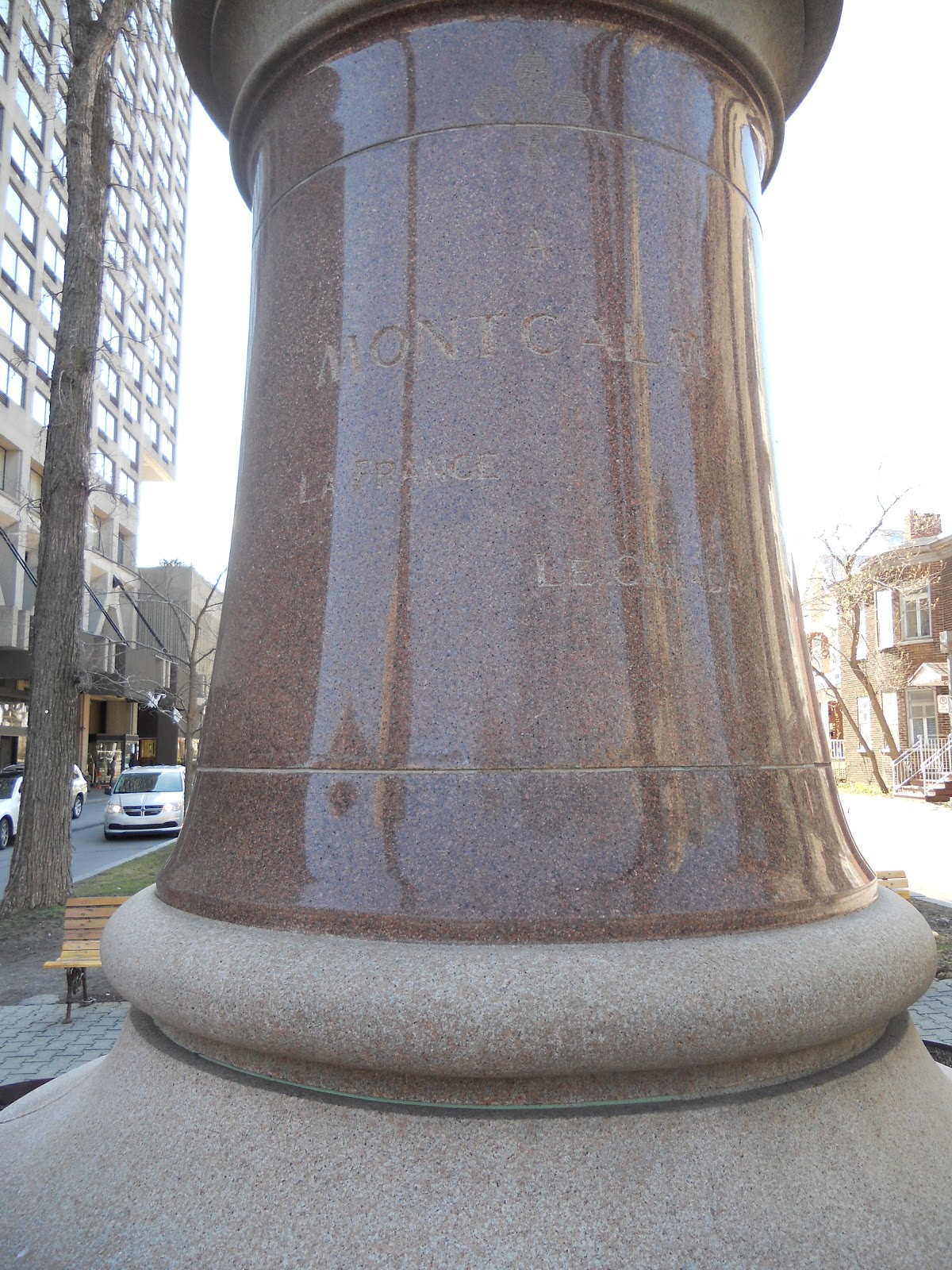
This is Léopold Morice's Monument to Montcalm, cast in 1910 and erected in 1911 facing the Grande Allée a few meters away from the Plains. The plans for the monument began, presumably at the time of the 1908 tri-centennial celebrations and the founding of the National Battlefields Commission. Today it stands in front of the concrete monstrosity of the Loews hotel and back to back with a bronze statue of Charles de Gaulle at the other end of a short median.

I don't think the statue really does the hero justice. The expression on his face and his pose, with both arms stretched out, suggests that the allegorical angel come to crown him with laurels has suddenly bumped into him and may topple him over. He straddles a cannon that lies on the ground in a position where it cannot possible aid him in battle. But let's look at the inscription on his pedestal.

The polished curved surface is hard to read. It says simply
    Montcalm
La France
         Le Canada

Another copy of this statue was unveiled in 1910 at Montcalm's birthplace, the Chateau de Vestric, in Vestric-Candiac, France, just south of Nimes. I've not seen a photo of that one, but its existence, and the inscription here in Quebec, suggests an emphasis on his French identity and the connection he provides between Quebec and France. This even though some of the major histories of the Seven Years War by Quebecois, including Guy Frégault and François-Xavier Garneau, tended to criticize Montcalm's battlefield leadership and favor that of the Canadian-born governor Vaudreuil.

Here is the plaque on the house now standing on the site of the house where Montcalm died, the day after the battle in 1759. This is one of the few inscriptions in the city that is not bi-lingual. It emphasizes his French birth. It was put there only in 1999, on the 240th anniversary of his death. The house faces Rue du Parloir, the short street where the cars of parents of Ecole des Ursulines students line up twice a day. Montcalm's remains were interred in chapel of the Ursulines until 2001, when a translation ceremony was held to move them to the cemetery of the Hôpital général de Québec, in the lower town. A nun at the Ursulines chapel recalled the event and said they had to dig a big hole in the floor, and that only part of his skull remained. However small the remains, they were carried in carriage pulled by four black horses and in a procession to the new site. I need learn the reasons for this move, but at the same time a new monument was built there to the memory of soldiers who died during the Seven Year War and had been buried in an unmarked mass grave in that cemetery.

Montcalm got a new mausoleum as you see here, but the effect was nonetheless to democratize the hero by putting him alongside some of his troops.The plaque in the foreground reads in part: "Il repose desormais auprès de ses soldats tombés avec luis devant Québec pour la défense de la Nouvelle-France." Inside, too dark for photos yesterday, is another inscription explaining that at the ceremony his descendant laid a stone from the ancestral castle at Saint-Véran, France next to his relics. So we see how the fetishism of objects inheres not only in holy relics, but even in buildings, stone, monuments, etc. To translate remains is to transfer the magical power of heroism or ownership, from one place to another. These "restes" carry a magical aura, that apparently can be felt by the remains of the soldiers who must be comforted at the thought that their leader now lies close to them.


mercredi 9 mai 2012

Monument des Braves

One response of Quebec francophones to the cult of memory surrounding Wolfe and the battle of Sept. 13, 1759, has been to emphasize the Battle of Ste-Foy fought the following year on April 28th. In this battle the Chevalier de Lévis, whom most historians regard as a more capable tactician than Montcalm, but who was away from the city in September 1759, attacked the English forces led by James Murray in an attempt to retake Quebec. He was able to inflict significant casualties, and then beseige the fortified city, but when British ships arrived two weeks later and relieved Murray, Lévis' effort failed, and the focus shifted to Montreal. Because the French carried the day at Ste-Foy, commemorations of this battle have been used as a counterweight to Wolfe and the Plains of Abraham. So when military reenactment hobbyists proposed activities on the occasion of the 250th anniversary in 2009, they promised to reenact both battles. And likewise when the National Battlefield Commission began designing the park, they included the Monument which already stood at the sight of the former Dumont mill, around which the Ste-Foy battle had been fought. Here is a reproduction of a painting of the battle by Joseph Legaré, on a signboard at the park.


The text of the signboard contains a detailed account of the military maneuvers which led Lévis to victory. It also explains how "in 1849, workers discovered bones and remains of weapons near the presumed site of the Dumont mill. Excavations conducted in 1852 seem to confirm that the remains were those of soldiers, both French and British, who died in the Battle of Sainte-Foy. ON June 5, 1854 a translation ceremony was held, at the end of which a casket containing the soldiers' remains was lowered into a grave on the battlefield, where the monument was later erected."
The battlefield commission seems reluctant to endorse the authenticity of these finds. I also like the way the verb "translated" has the obscure meaning of "the removal of the body or relics of a saint to another place of interment" [OED I 1. a]. As we have seen, translation between English and French is also an important element of the commemoration process.


The monument is at the north end of the Avenue des Braves, a street of sumptuous residences, which runs from the eastern end of Battlefields park. It's about a kilometer to walk, and so few tourists who see the Wolfe Monument and other sites in the park are likely to make the trip, although in the high season there is a shuttle bus.

The monument itself was commissioned by the Societe Saint-Jean-Baptiste de Québec (the francophone social/political club, which had purchased the land in 1855), designed by celebrated architect Charles Baillargé, and erected in 1860. It has the Roman goddess of war, Bellona, on top, and plaques on opposite sides honoring Levis and Murray.


 So it seems clear that the SSJB wanted to reply to the Wolfe monument and the Dalhousie one by putting up their own to the 1760 battle, which was a French victory, but they made it appear non-partisan by using a design similar to the Dalhousie monument, with paired French and English heroes, plaques with the name of each facing away from each other on opposite sides of the monument even as they faced toward each other on the battlefield.

There are also, in an adjoining shelter added much more recently, two bronze statues of the two heroes. The francophones were already in the mid 1800s adept at monumental balance, at giving equal time to both sides so as to avoid offending the Anglophones who held greater economic clout in the city. The same kind of delicacy is often required today when building historical monuments and composing plaques and texts, whether in the U.S. or Canada, and whether the issue is the Civil War, or slavery, or what-have-you.

The only way the francophones can celebrate their own side is to do so obliquely. Thus, for instance, the first stone in the construction of the monument was laid in June 1855 by the captain of the Capricieuse, the first French military vessel to reach Quebec since the Conquest 96 years earlier. In our next posts we will see more examples of this oblique patriotism.